August 24, 2026
From subsidence to flash flooding – why insurers are preparing for weather whiplash
The UK is experiencing another summer of extreme weather, but for insurers the immediate...
Rehabilitate drains to eliminate rat infestation
Cockermouth, Cumbria
Insurance provider
An insurance company called in Catalyst Services UK to assist an elderly and vulnerable man whose home had been experiencing persistent rat infestations.
The 1990s semi-detached brick-built house was constructed on a block and beam suspended floor. A preliminary CCTV inspection identified multiple defects in the property’s drainage system.
This led to a full CCTV survey to establish the extent of the defects. The 100mm-diameter drain runs between inspection chambers at the back and the front of the house.
The survey identified severe defects along this pipe’s length, including fractures, breaks, large voids and partial blockages caused by ingress of foundation material. Past attempts to remove this blockage material had caused sections of pipe to collapse.
These defects were allowing rats to enter the drain from the main sewer 10 metres away and get into the void area under the block and beam flooring, where they appeared to be nesting.
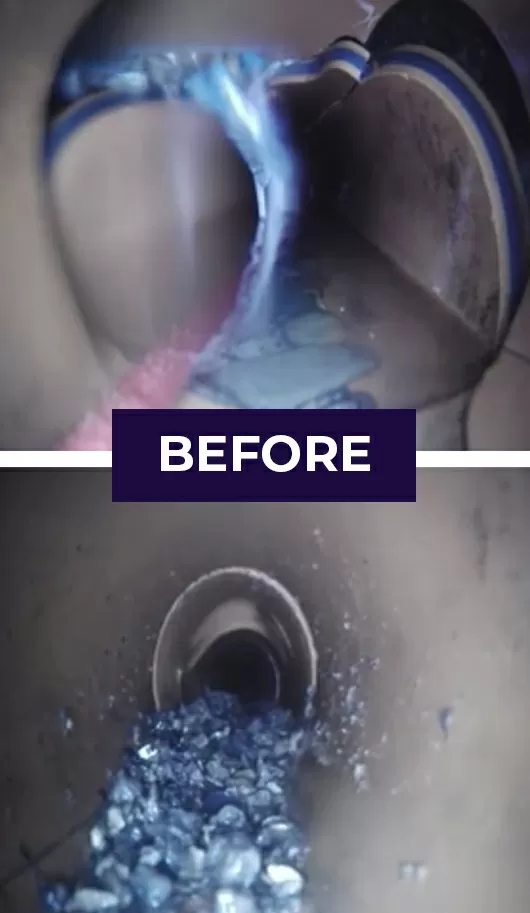
The drainage pipes were so damaged that it was legitimate to consider excavating and replacing them.
However, by lifting a section of flooring in the house, and removing a number of the concrete blocks, it became clear this would require a substantial section of the floor to be lifted and the beams cut.
Therefore, Catalyst commissioned an investigation into the option of rehabilitating the drainage pipe using no-dig (trenchless) cured in place pipe (CIPP) lining.
Two CIPP lining techniques were used to: 1. Stabilise the badly damaged drainage pipe, then 2. Rehabilitate the drain to give it long-term viability.
A jet vac tanker, delivering low pressure jetting, plus mechanical equipment were used to remove debris from the drainage system.
As each section of pipe was cleaned in this way, remote structural repairs (RSRs) – also known as patch liners – were installed to prevent the pipe from collapsing.
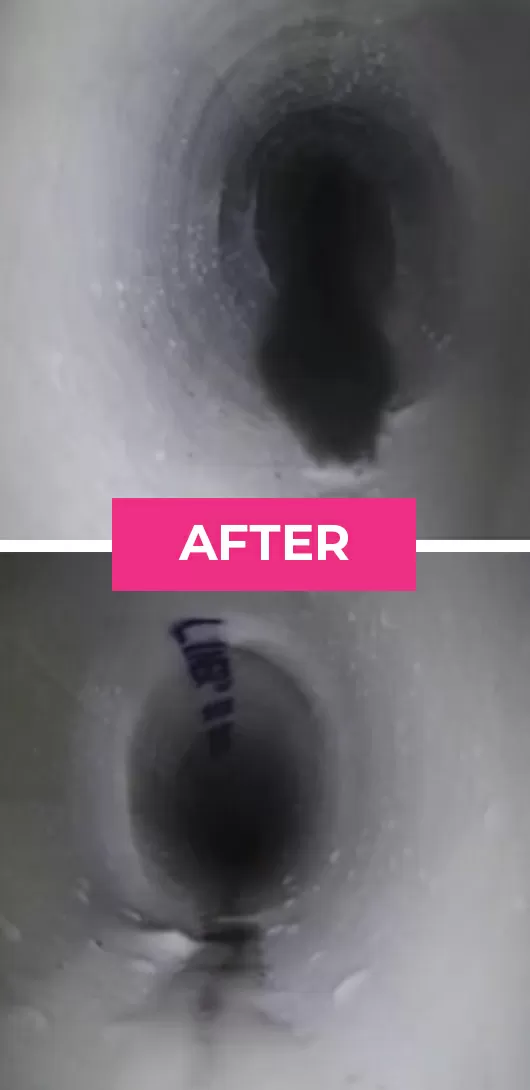
A patch liner is a short CIPP liner impregnated with resin. This is tied to an inflatable packer and placed inside the damaged pipe.
The liner is left to cure in ambient temperature to form a tough, water-tight pipe within a pipe. The packer can then be deflated and removed.
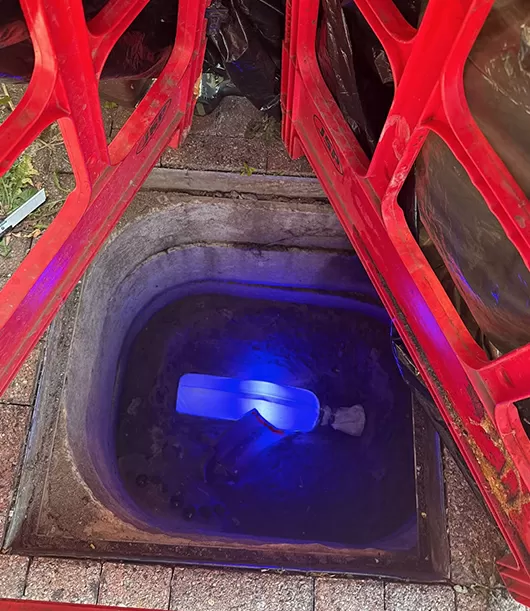
An LED light CIPP system was then used to install 2 liners with a combined length of 13.55 metres into the pipe.
Liner 1 – From an inspection chamber at the back of the house to another inspection chamber in the front garden. Length: 10.24 metres.
Liner 2 – From the inspection chamber in the front garden to the property boundary. Length: 3.31 metres.
The no-dig lining system used blue LED light to cure specialist vinyl ester resins incorporated in the liner which react only to the specific wavelength of blue light.
The short section of pipe leader from the inspection chamber at the front of the house to the main sewer outside the property’s boundary was also found to have fractures and breaks.
Therefore, it was decided to install a blind-shot liner (one that is not installed from access point to access point) to the property boundary.
A lateral connection from a pipe serving a downstairs toilet into the lined pipe was reopened using a robotic cutter.
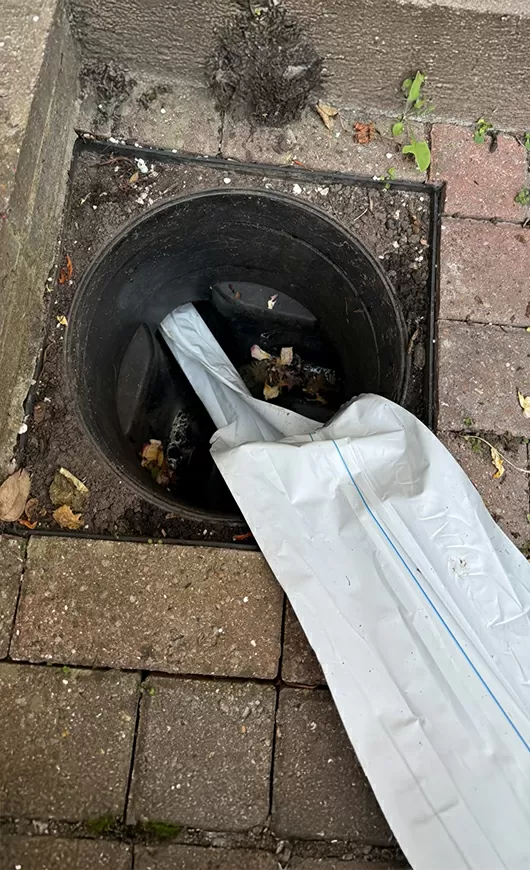
LED light CIPP lining is ideal for rehabilitating small-diameter pipes in houses:
Best technical solution: lining the pipe in this way created a fully-rehabilitated, seamless, robust drainage pipe with a design life of a minimum of 50 years.
Solving the problem: the process eliminated voids that were allowing rats to infest the area beneath the property’s suspended floors.
| The Policyholder | The Insurance Client |
|---|---|
| Least disruption: The elderly policyholder could stay in his home during the work. | Cost control: Rehabilitating the pipe system was the least expensive solution available, with a budget a fraction of pipe replacement. |
| Fast and efficient: CIPP LED lining was the fastest and least intrusive of any solution available. | Customer satisfaction: The insurance company’s customer was very pleased to be able to stay in his home. |
| Best support: Catalyst liaised with the policyholder during the works to ensure he kept informed and agreed with all actions taken. | Most sustainable: Lining the pipe was most carbon-efficient and generated least waste of all solutions. |
They include: subsidence investigations, drainage surveys and repairs (mains and off-mains), water supply pipe repairs and replacement, water leak detection, and environmental services.
Talk to us today about how we can help.
Helping business and domestic customers every day of the year

August 24, 2026
From subsidence to flash flooding – why insurers are preparing for weather whiplash
The UK is experiencing another summer of extreme weather, but for insurers the immediate...
July 30, 2026
Dom does the double with second Kudos Award
Property Claims Handler Dom Weiss has proved he provides consistently excellent support for customers...

July 17, 2026
The heat is on – how climate change is impacting below ground services insurance claims
This summer’s heatwaves, and the climate change behind them, are putting homes and business...