
October 12, 2026
Resource hub refresh puts expert technical advice at your fingertips
Insurance claims professionals now have faster access to the expert advice they need in...
Service illustrations
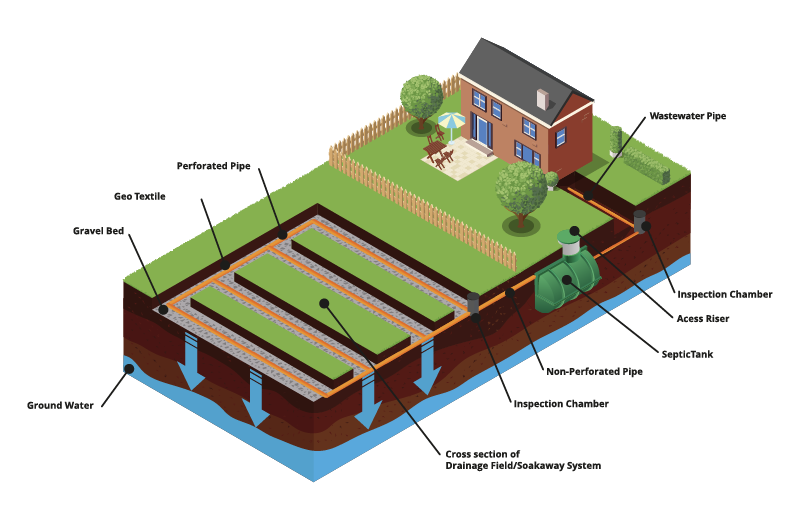
A drainage field is an underground network of perforated pipes that safely disperses wastewater from a septic tank or small sewage treatment plant into the surrounding soil.
It is sometimes called an infiltration system or a leach field. It is not the same as a conventional of a soakaway, commonly made from plastic crates, rubble or a single deep pit to drain surface water.
A well designed drainage field spreads wastewater over a relatively large, shallow area so it can receive further biological treatment in the soil.
A drainage field forms part of a wider off-mains drainage system.
Water from toilets, sinks, showers, baths, washing machines and other foul drainage flows into a septic tank or sewage treatment plant.
In a septic tank, heavier solids settle to the bottom as sludge, while oils and lighter material form a floating layer. The partially treated liquid between these layers flows out of the tank.
A sewage treatment plant provides, or package treatment plant, provides additional biological treatment, so its outgoing effluent is generally treated to a higher standard.
The effluent passes through an inspection or distribution chamber and into a network of perforated pipes. The pipes are usually laid in gravel or clean stone-filled trenches, allowing the liquid to trickle out gradually across the field rather than being discharged at one point.
As the effluent moves through the unsaturated soil, soil particles filter it and naturally occurring microorganisms break down organic matter and reduce pollutants.
Oxygen in the upper layers of soil is important to this process, which is why a drainage field is generally shallow and spread over a wide area.
After passing through suitable soil, the water continues downwards and eventually joins the groundwater system. There should be no visible discharge, standing sewage or permanently waterlogged ground at the surface.
Helping business and domestic customers every day of the year

October 12, 2026
Resource hub refresh puts expert technical advice at your fingertips
Insurance claims professionals now have faster access to the expert advice they need in...

October 12, 2026
New Catalyst service guide – sharing the facts about off-mains drainage
Catalyst Services UK has a launched its latest service guide, providing accurate and authoritative...
August 24, 2026
From subsidence to flash flooding – why insurers are preparing for weather whiplash
The UK is experiencing another summer of extreme weather, but for insurers the immediate...