
October 12, 2026
Resource hub refresh puts expert technical advice at your fingertips
Insurance claims professionals now have faster access to the expert advice they need in...
Service illustrations
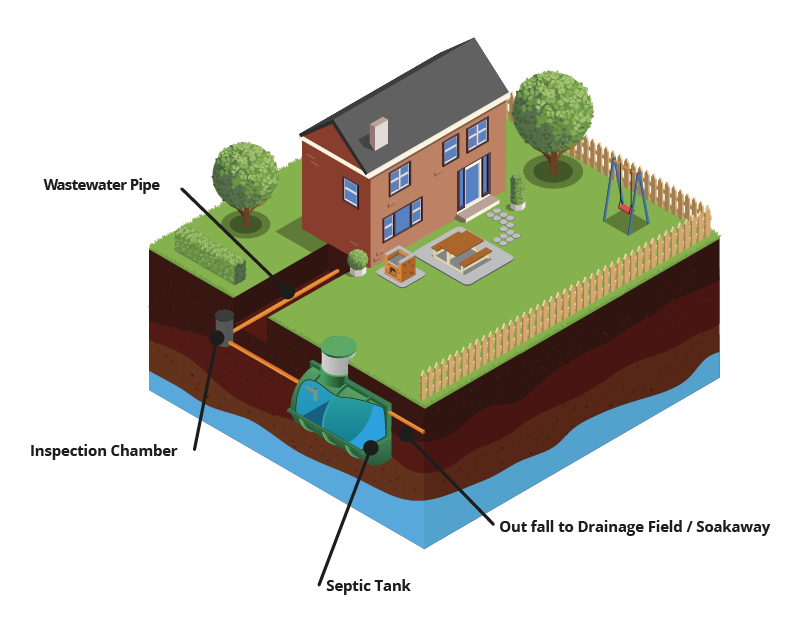
Septic tanks are underground holding tanks for wastewater (liquid waste that can include toilet waste, dirty kitchen water and water from clothes washing machines).
They process the wastewater by separating liquids from solids. Wastewater enters the septic tank through an inlet pipe. It is deposited in the tank through a dip pipe.
As the wastewater builds up in the tank, heavier solids sink to the bottom of the tank, while lighter solids, including fats and oils, collect on the surface. This leaves liquid effluent in the middle.
Another dip pipe, usually located on the other side of the tank, then draws off the liquid effluent which is usually dispersed into the ground via a drainage field, leaving the scum and the sludge inside the tank.
At regular intervals, before the tank becomes too full, this waste must be pumped from the tank and taken by tanker to be disposed of at an authorised waste site.
Some septic tanks have just one chamber. Others are designed with two or, sometimes, three chambers to improve the filtration process.
Helping business and domestic customers every day of the year

October 12, 2026
Resource hub refresh puts expert technical advice at your fingertips
Insurance claims professionals now have faster access to the expert advice they need in...
October 12, 2026
New Catalyst service guide – sharing the facts about off-mains drainage
Catalyst Services UK has a launched its latest service guide, providing accurate and authoritative...

August 24, 2026
From subsidence to flash flooding – why insurers are preparing for weather whiplash
The UK is experiencing another summer of extreme weather, but for insurers the immediate...